
Moving Life Insurance to the Top of People’s To-Do List

Moving Life Insurance to the Top of People’s To-Do List

Moving Life Insurance to the Top of People’s To-Do List

Do a deep clean? Or figure out how much life insurance you need?

When it comes to checking things off their to-do list, most people would rather clean out their email inbox (39%) or their basement or garage (31%) than figure out how much life insurance they need. One in five adults said they’d be willing to sit on hold with customer service for three hours rather than doing life insurance planning.

This data comes from the 2026 Life Happens Life Insurance Survey, released in conjunction with September’s Life Insurance Awareness Month, the public awareness campaign that Life Happens created and coordinates each year.

People would rather clean out their email inbox (39%) than figure out how much life insurance they need.
So, for those who don’t have life insurance, where does it fall on their current to-do list? More than half of people aren’t in any hurry to get it done: They have it at the bottom of their list (9%), on the “deal with it later” list (21%) or not on their list at all (26%).

The results may not be surprising, given that life insurance comes with a lot of feelings: 40% say they feel anxious, overwhelmed—or both, when thinking about life insurance, while 16% admit to feeling guilty for putting it off.

40% say they feel anxious, overwhelmed—or both, when thinking about life insurance.

Cost and Confidence

What is stopping them from looking into and getting the coverage they need? Cost concerns emerge as one of the biggest barriers. Overall, 64% say cost affects whether they look into life insurance, with 32% of those saying it affects their decision “a lot.”

While some have already addressed their needs and feel confident, others remain uncertain even after taking action, suggesting that completing the task does not always eliminate confusion. The divide between genders is telling: 53% of men say they have life insurance and are confident they have enough, while only 41% of women say the same. Generationally, Gen Z seems the most confident in their decision that they have enough life insurance (53%) versus 46% of Millennials and 40% of Gen X.

Encouragingly, the findings indicate that perceptions can be shifted through education and reassurance. Overall, 55% say if they learned that life insurance may be easier to get than they expected, they would be “more likely” to start the process, including 30% who say they would be “much more likely.”

Overall, 64% say cost affects whether they look into life insurance, with 32% of those saying it affects their decision “a lot.”

Here is what people said would specifically make them more likely to look into life insurance:

Total Gen Z Millennials Gen X
Knowing it may cost less than I assumed 30% 28% 31% 30%
A recommendation from someone I trust 24% 27% 25% 20%
An online calculator to see how much I need 22% 25% 23% 16%
A major life event (baby, home, job) 21% 28% 22% 11%
A  conversation with an insurance professional 20% 24% 19% 16%
Overall, the research suggests that reducing perceived complexity, correcting cost misconceptions, and offering digital tools and professional guidance could help move life insurance to the top of people’s to-do list.

Methodology: Life Happens commissioned Atomik Research to conduct an online survey of 2,000 adults, including 700 Gen Z respondents, 700 millennials, and 600 Gen X respondents throughout the United States. The margin of error for the overall sample is +/- 2 percentage points and +/- 4 percentage points for each generational sample, with a confidence level of 95 percent. Fieldwork took place between July 14 and July 20, 2026.

Please source all statistics cited: 2026 Life Happens Life Insurance Survey

Discover more

For more information on this study and its methodology, view our press release.
Share

What Consumers Want (and Need): Education, Customization and Professional Advice

What Consumers Want (and Need): Education, Customization and Professional Advice

What Consumers Want (and Need): Education, Customization and Professional Advice

The Insurance Barometer Study, now in its 16th year, tracks consumers’ perception about life insurance and related products. More than a decade and a half of data helps paint a picture of what products consumers think they have, what they are interested in buying and what might be stopping them from doing so.

Life insurance ownership (reported as what consumers say they have) has stayed steady for a number of years at about half of adults (52%). Additionally, there is a consistent number of those who don’t have it, but recognize they need it (29%), and those who have life insurance and say they need more (9%). This gives the industry 99 million adults who could use help getting coverage.

Life Insurance Ownership
  • Gen Z 44% 44%
  • Millennials 50% 50%
  • Gen X 58% 58%

And why is that? It may be a mix of factors, starting with lack of knowledge. Education is key to changing minds and habits, and 4 in 10 adults say they are only somewhat or not at all knowledgeable about life insurance.

Then we can add in the steady-state reasons people have given over the years for not having coverage: perceived cost (45%), other financial priorities (35%), confusion over what kind or how to buy (23%) and procrastination (23%). These numbers are much more elevated with the younger generations. (See chart.) While we may not be able to directly address “other financial priorities,” the other three reasons are straightforward to educate people and motivate them to purchase coverage.

4%
of consumers 30 and younger correctly priced a basic life insurance policy.
Reasons Gen Z and Millennials don’t own life insurance:
Gen Z Millennials
Not sure how much I need or what type to buy 33% 28%
Haven’t gotten around to it 33% 31%

LTCI and DI Misconceptions

Misunderstanding about products also extends into disability insurance (DI) and long-term care insurance (LTCI) as well.

This year’s survey asked a series of true/false questions on disability insurance, which reveal lack of knowledge in large segments of the market:

  • 52% don’t think they can get DI outside of their employer
  • 40% believe they need full medical underwriting to get short-term DI
  • 27% think long-term DI pays their full salary until they return to work

And when it came to long-term care coverage, there are also large knowledge gaps, including:

  • 58% erroneously believe LTCI requires policyholders to “use it or lose it”
  • 57% think LTCI is more expensive than the average cost of care
  • 71% think LTCI is too expensive

Help Is on the Way

People do want help from an insurance agent or financial professional, despite the proliferation of things like AI tools and simplified issue to reduce friction in getting coverage. In fact, 45% say they already work with a professional, and 26% say they are currently looking for one to work with.

The survey asked respondents who have or are seeking a financial professional which contact method they prefer when they have an insurance, investment, or savings question. The top response (31%) across the generations was “in person,” and interestingly 29% for Millennials and Gen Z. Looking further, if you add telephone and video chat in to the “in person” response, 53% prefer speaking to a financial professional to other options.

Yet, we can’t discount what is also happening on social media, as 62% of adults say they use social media when seeking information on insurance and financial products and services, and 46% of those people say that keeping in touch with a financial professional on social media is important.

31%
of consumers prefer in-person conversations.

What Will Motivate Them to Buy?

What product enhancements would entice consumers to get coverage? When asked about features or add-ons to life insurance that would make it more appealing (keeping in mind some of these currently exist, while others don’t/may never), people said things they can leverage in the here-and-now, like income during retirement and long-term care and critical illness coverage. They also responded favorably to the ability to customize a policy/plan.

The survey also showed that many consumers would respond to things like a term-to-permanent conversion policy where they as the policyholder can initiate the changes, or a long-term care rider that can be added or added to in the future.

 
Gen Z
 
Millennials
A policy that allows benefits to be used for critical illness if necessary
  • 70% 70%
  • 78% 78%
A policy that allows benefits to be used for long-term care services if necessary
  • 72% 72%
  • 76% 76%
Having health screenings to lower the cost of coverage
  • 68% 68%
  • 71% 71%
Taking health courses to lower the cost of coverage
  • 62% 62%
  • 69% 69%
Sharing fitness/wellness data with your insurer to lower the cost of coverage
  • 58% 58%
  • 64% 64%

Financial Woes, but We Have Solutions

The Barometer Study also asks questions about people’s general financial well-being. Over the years, participants have expressed the same group of top financial concerns: having enough money for a comfortable retirement, being able to save for an emergency fund, supporting themselves through a disability and paying for long-term care services.

The good news is that our industry is uniquely poised with products and services to help them with three of those four concerns.

Additionally, around half of people said they would feel the financial impact of the “loss” of the primary wage earner due to disability (51%) or death (46%) within six months.

The industry has work to do, but it has the products and the expertise to help consumers solve these concerns.

 
Gen X
 
Millennials
 
Gen Z
Comfortable retirement
  • 48% 48%
  • 45% 45%
  • 43% 43%
Emergency funds
  • 38% 38%
  • 40% 40%
  • 41% 41%
Supporting self through disability
  • 40% 40%
  • 39% 39%
  • 37% 37%
Long-term care services
  • 39% 39%
  • 35% 35%
  • 30% 30%
Please source all statistics cited: 2026 Insurance Barometer Study, Life Happens and LIMRA
The full 2026 Insurance Barometer Study is available to Life Happens partner companies and can be accessed here. If you have issues accessing it, please contact partnerships@lifehappens.org. For media inquiries, contact mleyes@lifehappens.org.

Discover more

For more information on this study and its methodology, view our press release.

Share

Life Insurance in the (Mis)Information Age

Life Insurance in the (Mis)Information Age

Life Insurance in the (Mis)Information Age

Share:

Even as rapid shifts in the digital landscape transform our industry, there is still a need for human insight, creativity and interaction to help more Americans get the life insurance coverage they need. This stands out in “Life Insurance in the (Mis)Information Age,” the second report from the 2025 Insurance Barometer Study, by Life Happens and LIMRA.

The study shows that social media has become a dominant source for financial and insurance education and information, especially for younger generations, while artificial intelligence (AI) is emerging as a key tool for research and shopping. Despite these changes, trust in financial professionals remains high, with most consumers still wanting human guidance at key stages of the life insurance purchase journey.

Here are some findings that highlight both the opportunities and challenges for our industry:

Use of Social Media for Financial Information

Social media has grown into a primary source of financial information, particularly among younger adults. With more than six in 10 Americans using social media when looking for financial and insurance information, companies must find ways to stand out in a crowded space where unregulated influencers often compete with licensed professionals.

  • 62% of Americans use social media for financial/insurance information, up from 29% in 2019
  • Social media usage is strongest among younger adults: 84% of Gen Z; 78% of Millennials
  • Top platforms: YouTube, Facebook, Instagram (order varies by demographic)
  • Gen Z trusts “experts/influencers/spokespeople” on social media about as much as family/friends

    84%

    of Gen Z use social media when seeking information on financial and insurance products and services.

    Roll of Financial Professionals

    Trust in financial professionals remains a cornerstone of consumer confidence, even as digital tools proliferate. Most Americans say they value professional guidance, but barriers, such as perceived cost and a do-it-yourself mindset, keep some from seeking help from a professional.

    • 78% of adults say they trust financial professionals
    • 43% currently work with one; 94% of those say they are “somewhat” or “very” likely to trust them
    • Reasons given for not working with a professional: cost (40%), preference to “do it myself” (40%), and “don’t make enough money to need one” (29%)
    • Desired traits: experience (81%), specialized focus (62%), recommendations from friends/family (54%), empathy/kindness (43%)

    94%

    of those who work with a financial professional say they trust them.

    AI and the Digital Shift

    AI tools are now part of the consumer decision-making landscape, with many using them to research or shop for insurance. While some buyers are comfortable completing a life insurance purchase online, most still seek human input at pivotal points.

    • 1 in 4 consumers would complete a life insurance purchase entirely online
    • Of those who still want human help, they would turn to a professional …
      • 18% – very early on in the process
      • 24% – early on (not sure of what kind of life insurance is best)
      • 36% – after narrowing product type but before deciding amount/price
      • 18% – after deciding on type and how much
      • 5% – at the very end to wrap up any lingering questions
    • Over half of respondents reported using AI tools for research (51%) and shopping (55%) but the industry cannot control the accuracy of AI outputs

    3 in 4

    people say they still want professional help in the life insurance buying process.

    Opportunities Await

    The convergence of social media, AI and professional guidance creates a moment of risk and possibility. Companies and financial professionals can succeed by producing transparent, relatable digital content; educating about cost but reinforcing value over price; and ensuring compliance does not keep them from competing effectively in the spaces where consumers are already active.

    Please source all statistics cited: 2025 Insurance Barometer Study, Life Happens and LIMRA
    The full 2025 Insurance Barometer Study is available to Life Happens partner companies and can be accessed here. If you have issues accessing it, please contact partnerships@lifehappens.org. For media inquiries, contact mleyes@lifehappens.org.

    Discover more

    For more information on this study and its methodology, view our press release.

    Share

    They Don’t Understand Life Insurance and Overestimate Its Cost

    They Don’t Understand Life Insurance and Overestimate Its Cost

    They Don’t Understand Life Insurance and Overestimate Its Cost

    Share:

    It’s an affordable means of financial stability that people think they can’t afford (when most actually can). 

    What is it? Life insurance.

    The 2025 Insurance Barometer Study, research that Life Happens and LIMRA have conducted for 15 years, shows that about three-quarters of adults overestimate the true cost of life insurance.

    We’ve asked this question since the study’s inception, but this year we drilled down further. We asked respondents to self-assess their health and then to estimate what a term policy would be for themselves at their current age.* And even the youngest (those 35 and under) and healthiest overestimate what life insurance would cost them by seven to 12 times.

    Adults (35 and under) who say they are healthy overestimate the cost of life insurance by 7-12 times.

    When you look at why people with a need gap don’t buy life insurance, the most common reason they give is cost (46%). Understanding that this is a consumer perception study, if they have incorrect assumptions about the cost of life insurance, it follows that they think they can’t afford it.

    This may come down to education. In fact, 41% of adults say they are only somewhat or not at all knowledgeable about life insurance. If you don’t understand the key qualities of the product, estimating its cost will be difficult. Combatting this misconception means we need to educate people about what life insurance is, what it does, and that it is a means to financial stability that most can afford.

    Education and outreach can also help clearly address two of the other most common reasons people give for not having life insurance: unsure of how much and what type to get (22%) and procrastination (21%).

    Life Insurance Ownership

    Half of American adults (51%) say they own life insurance. They may have it through their employer (26%), a policy they own individually (55%) or a combination of both (19%).

    Interestingly, 61% of those who do not have life insurance say they need it. Plus, 19% of those who do have some coverage say they could use more.

    In addition, given that this is a consumer perception study, there is likely a percentage of those who do not have life insurance and say they don’t need any who in actuality do have a need for coverage.

    Overall, the life insurance need gap means there are about 100 million Americans who are in the market for life insurance.

    This need gap is highest among:

    • Households earning under $50,000 per year
    • Consumers who identify as Hispanic or Black
    • All generations younger than Baby Boomers, representing 81 million adults
    • Women

    61%

    of those who don’t have life insurance say they need it.

    Educate Them Where They Spend Time

    The financial services industry has been reticent to use social media channels to reach consumers. However, 62% of all adults—and 80% of those under age 45—use social media to seek information on financial or insurance products. This is up from 29% when this question was first asked in 2019.

    Additionally, nearly half of Gen Z and Millennials say they value recommendations from experts, influencers or spokespeople. Of young adults who use social media for financial information, 45% say they follow financial advisors and 33% say they follow financial influencers.

    This is an untapped resource for this industry and an important means of guiding and educating a populace that has ingrained misconceptions about life insurance, including it affordability. 

    The need to educate Americans and help them get the coverage they need is as critical as ever: One in four adult Americans say their household would feel the financial impact of the death of the primary wage earner in one month or less. We have the means to change these statistics through education and offering life insurance solutions that fit their budget.

    6 in 10

    use social media when seeking info on financial or insurance products.

    * They were asked for the cost of a $250,000, 20 year level term life insurance policy. In past years, they were asked to estimate the cost of this policy for a healthy 30 y/o male.

    Please source all statistics cited: 2025 Insurance Barometer Study, Life Happens and LIMRA

    The full 2025 Insurance Barometer Study is available to Life Happens partner companies and can be accessed here.

    If you have issues accessing it, please contact partnerships@lifehappens.org.

    For media inquiries, contact mleyes@lifehappens.org.

    Discover more

    For more information on this study and its methodology, view our press release.

    Share

    “Adulting” Across the Generations

    “Adulting” Across the Generations

    “Adulting” Across the Generations

    What does it mean to be an adult, and at what age does it actually happen for people? Life Happens sought the answers through a generational lens, with some surprising results.

    Here’s what we found:

    For more information on this study, view our press release.

    “Adulting” is hard—and it seems to be getting harder, with 71% of people agreeing that it’s harder to be an adult now than it was 30 years ago. Almost the same number—72%—attributes it to the higher cost of living than ever before.

    In fact, being an adult doesn’t automatically start the day you turn 18. Instead, the age when life, money and the future start to feel “real” is 27 years old.

    This data comes from the Life Happens survey “Adulthood Across Generations.” It was conducted by Talker Research and polled 2,000 Americans split evenly by generation: 500 each of Gen Z adults, Millennials, Gen Xers and Baby Boomers.

    So, how do people define “adulting”? The top two answers were related to finance, with half saying it meant being able to pay their own bills (56%) and being financially independent (45%). In addition, many people said they “felt” like an adult when they moved out of their parents’ home (46%).

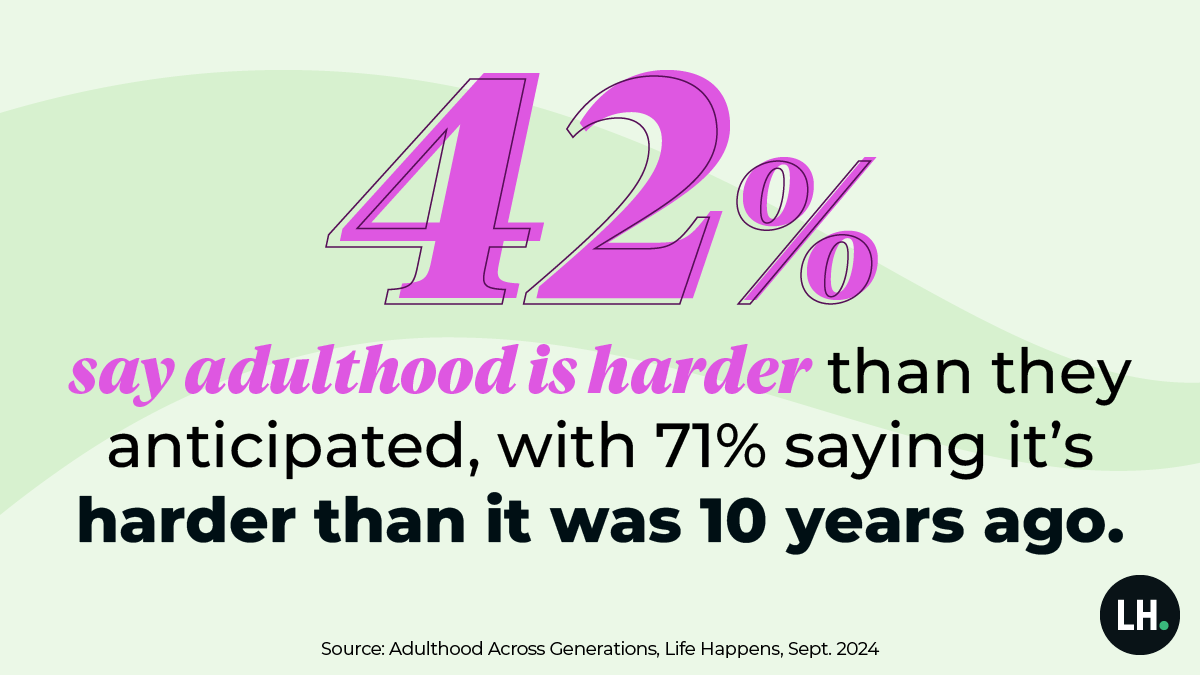
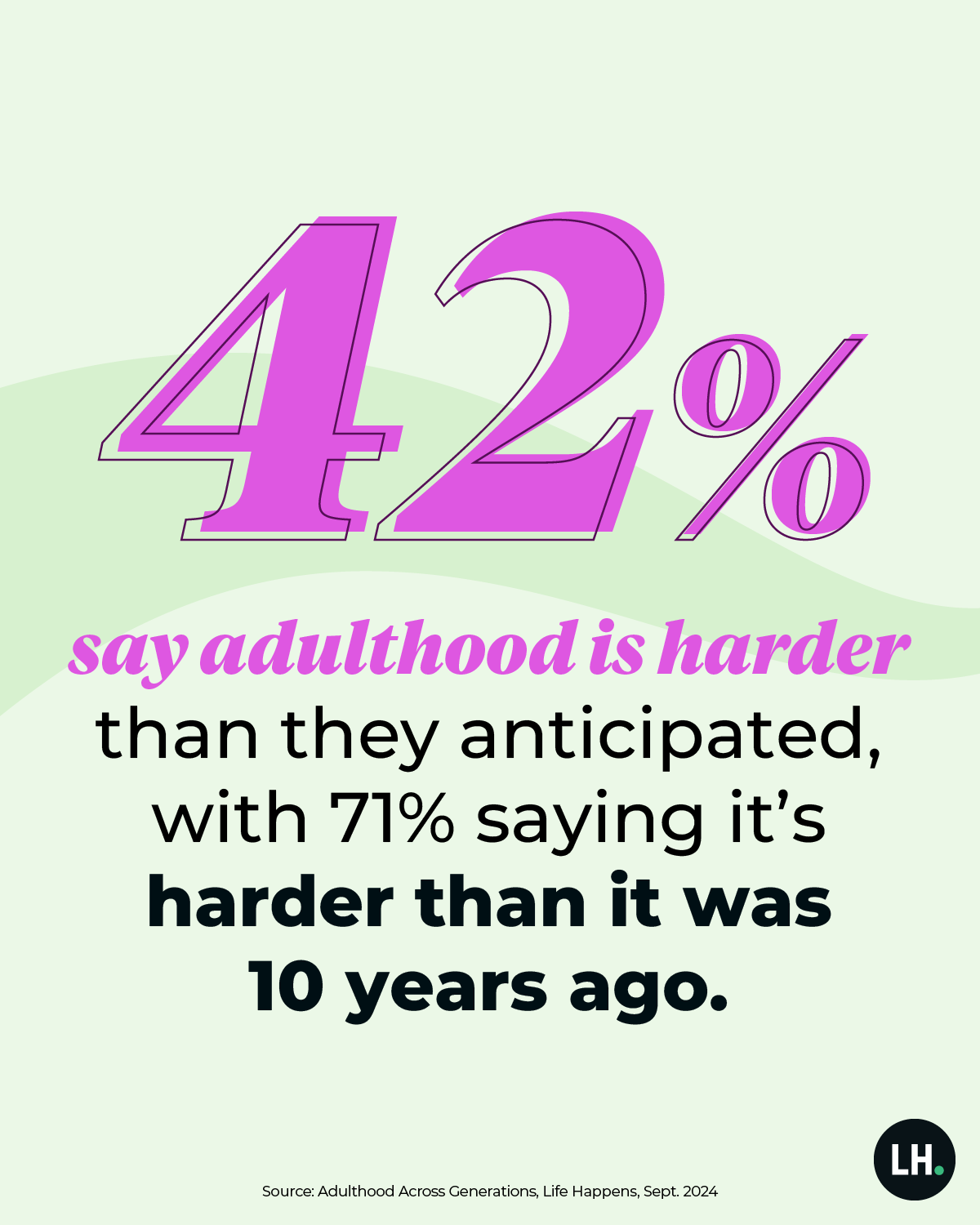
    42% say adulthood is harder than they anticipated, with 71% saying it's harder than it was 10 years ago.
    42% say adulthood is harder than they anticipated, with 71% saying it's harder than it was 10 years ago.
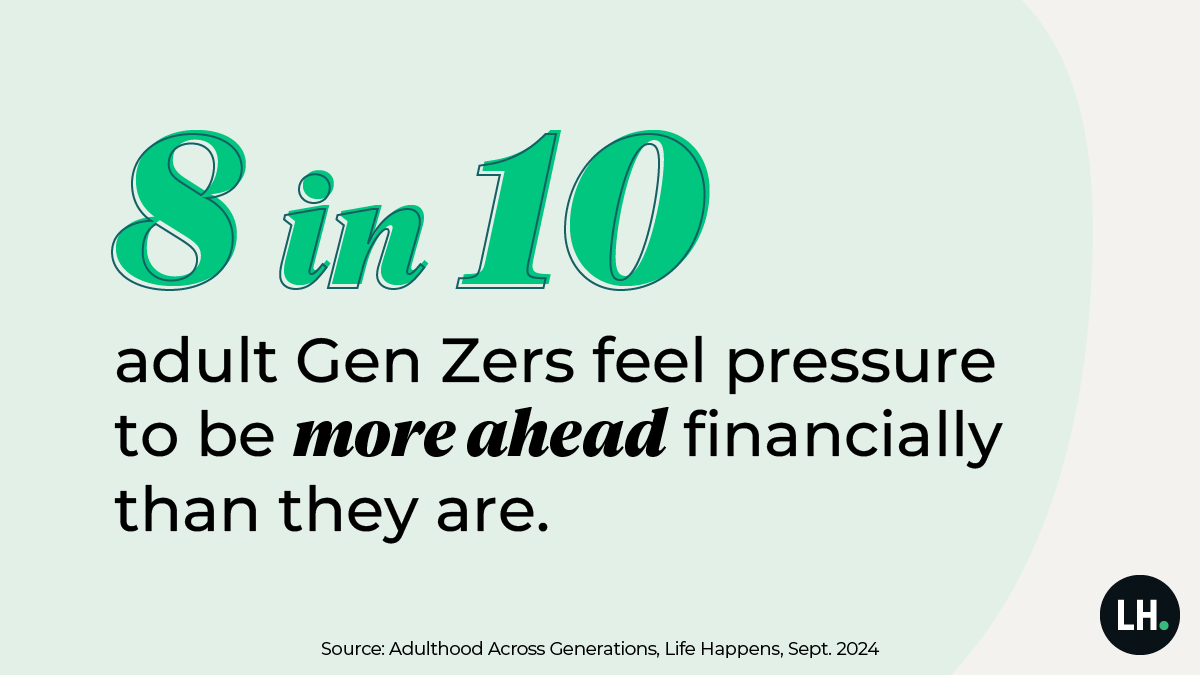
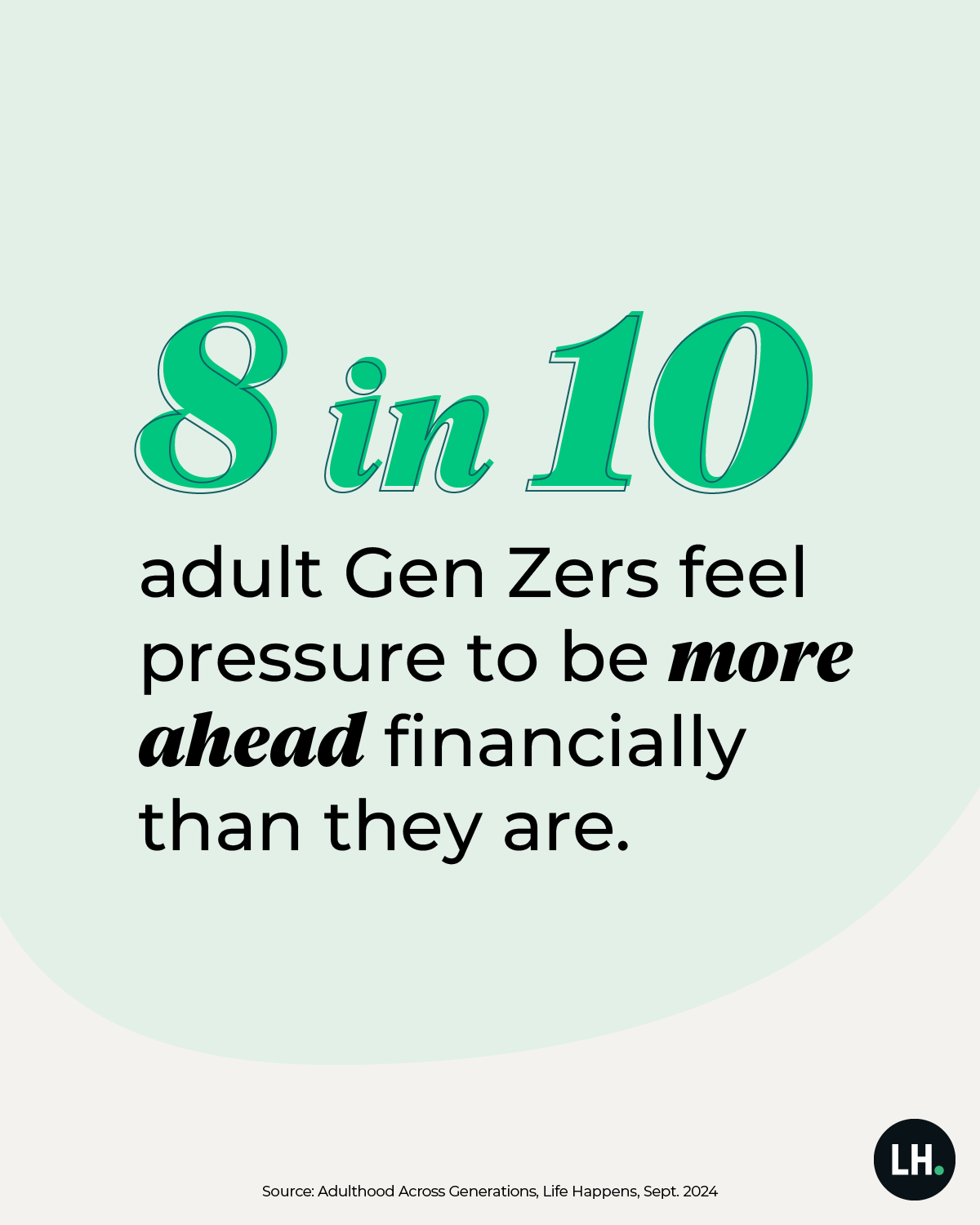
    8 in 10 adult Gen Zers feel pressure to be more ahead financially than they are.

    Gen Z Is Making Strides

    Interestingly, the age of “feeling” like an adult—age 27—coincides with the age when people started taking finances seriously—around age 28. That said, the older generations admit they wished they’d taken their finances more seriously in their 20s (76%).

    And while the oldest of Gen Z is just reaching that age of “adulting,” they are actually on the same page with the older generations with the top three pieces of financial advice they’d share. Here’s the consensus across generations: Start saving early (64%); create a budget (46%) and start building credit as soon as you can (41%).

    Gen Z is also ahead of the financial curve, as many are paying their own bills, getting credit cards, learning how to budget and opening savings accounts around age 22—younger than any of the other generations. However, half of Gen Z admit that they have not started contributing to a retirement plan.

    So, what financial “adulting” moves does Gen Z feel they cannot afford? Buying a home or apartment tops the list (47%), along with having kids (39%). Plus, more than half (56%) say they have more financial responsibility than they can handle.

    8 in 10 adult Gen Zers feel pressure to be more ahead financially than they are.
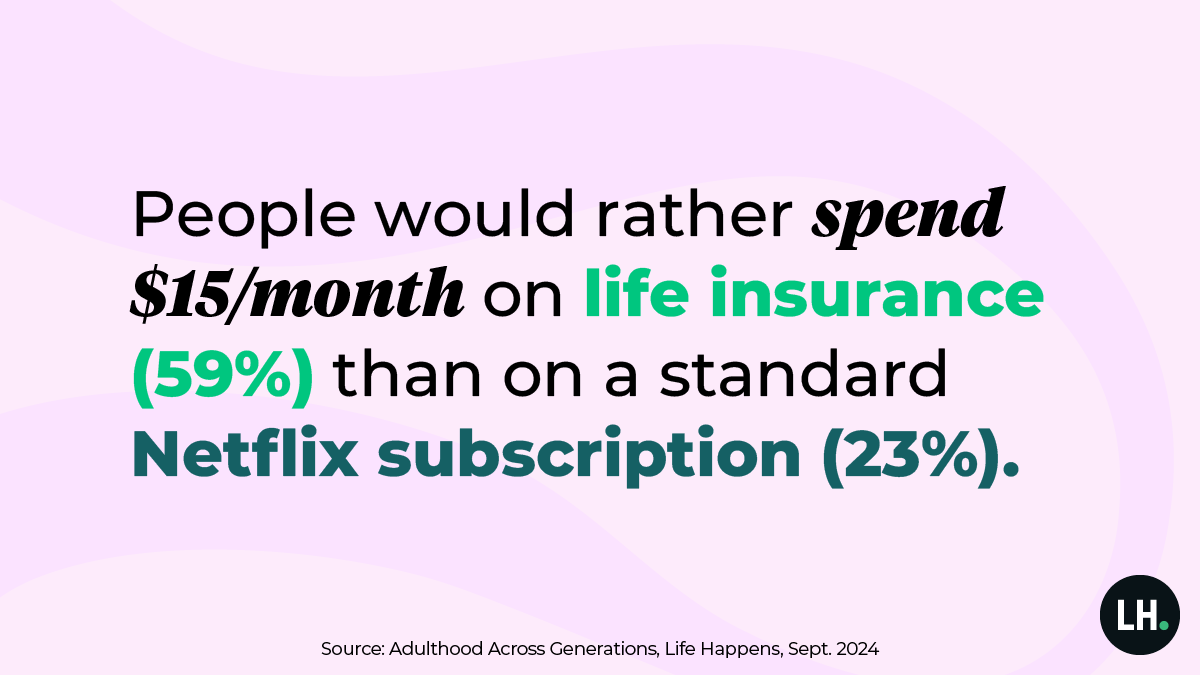
    People would rather spend $15/month on life insurance (59%) than on a standard Netflix subscription (23%).

    Being Financially Prepared

    While Americans are hoping that they’ll be financially stable by the age of 46, four in 10 respondents don’t believe they’ll ever achieve financial stability.

    When it comes to working with a financial professional, the average age when they first started was 30, but keep in mind that more than half (56%) say they have never taken this step.

    There is good news regarding retirement savings: with each generation, the average age when people started contributing to a retirement plan keeps getting younger, giving them a longer time to save and invest. The same can be said for life insurance. The younger generations are purchasing their first policy earlier than previous ones. In addition, four in 10 agree that getting life insurance “makes you an adult,” with more than half of Gen Z saying so (53%).


    Age when you … started saving for retirement … bought life insurance
    Gen Z: 22 22
    Millennials: 27 28
    Gen X: 31 33
    Baby Boomers: 34 34
    People would rather spend $15/month on life insurance (59%) than on a standard Netflix subscription (23%).
    People would rather spend $15/month on life insurance (59%) than on a standard Netflix subscription (23%).

    And some encouraging information: When asked if they would rather use $15/month for life insurance or a Netflix subscription, they all chose life insurance across generations.

    View the infographic and animation from this study.

    Please source all statistics cited: Adulthood Across Generations, Life Happens, Sept. 2024

    Survey methodology: Talker Research surveyed 2,000 Americans split evenly by generation (500 Gen Z, 500 millennials, 500 Gen X and 500 baby boomers); the survey was commissioned by Life Happens and administered and conducted online by Talker Research between August 12 to August 16, 2024 and released on Sept. 11, 2024.

    For media inquiries, contact lifehappens@kwtglobal.com.

    Discover more

    For more information on this study and its methodology, view our press release.

    Share

    Pin It on Pinterest